
Neurofeedback for Traumatic Brain Injury: Lifting the Fog
It's 3 p.m. and you have read the same email four times. The words are all there, but they slide away before they settle. There is an ache behind your eyes, the office lights feel too bright, and the tiredness arrives like a wall that coffee can't touch. Eight months ago you slipped on the stairs and hit your head. The scans were clear, the bruises faded long ago, and friends say you look like yourself again. Yet the person who used to juggle three projects before lunch now needs to lie down after the supermarket. And the question you keep asking is the one nobody can quite answer: when will I feel like me again?
After a brain injury, the hardest part is often not the injury itself, but living with symptoms that other people cannot see and that do not seem to follow any timetable.
If you are recovering from a traumatic brain injury or concussion, some of this may sound familiar:
The fog. Thinking feels slower, and conversations, emails and decisions take far more effort than they used to.
Memory gaps. Names, appointments and the reason you walked into a room slip away, so you rely on lists and reminders for everything.
Headaches and sensitivity. Noise, bright lights and busy places can quickly become too much.
Fatigue that rest doesn't fix. A short burst of concentration can leave you drained for the rest of the day.
A shorter fuse. Irritability, low mood or anxiety can appear out of nowhere, and the people closest to you feel it too.
Neurofeedback for traumatic brain injury, in a nutshell
A traumatic brain injury (TBI) can change the way brain regions communicate with each other, and EEG research shows that these changes can be measured in the brain's electrical rhythms. Neurofeedback is a scientifically based, measured way to train your brain to adjust its own activity towards a desired state. Your brain activity is recorded in real time, and a trained clinician monitors the live changes throughout each session, adjusts the training on the go and follows up on your progress, alongside the care you receive from your rehabilitation team.
In studies with people living with the after-effects of a brain injury, training has been associated with improvements in attention, memory and everyday functioning, and in one study with a return to work for everyone who had been employed before their injury.

Prefer to ask a quick question first? Message us on WhatsApp.
Brain injury is common, and often invisible
Brain injury is far more common than many people realise. According to the brain injury charity Headway, there were 335,409 UK hospital admissions for acquired brain injury in 2023–24, around 919 every day, including 123,969 admissions for head injury (Headway, n.d.).
Many head injuries are described as mild: a concussion from a fall, a sports collision or a road traffic accident. Yet for some people, symptoms such as poor concentration, memory problems, headaches, disturbed sleep, fatigue and irritability continue for months or even years. Because the injury cannot be seen, it is often misunderstood at work and at home, and people can feel that their struggles are put down to stress, low mood or simply not trying hard enough. They are not.
What is happening in the brain after a traumatic brain injury?
EEG (electroencephalography) measures the brain's electrical rhythms, or brainwaves. After a TBI, research has reported characteristic changes in these rhythms, including more slow theta activity, less alpha activity and reduced synchronisation of faster beta rhythms (Shah et al., 2020).
The same review describes how the balance between slow and faster rhythms has been linked to attention difficulties and to the course of cognitive recovery in the years after an injury. The way different brain regions coordinate their activity, known as coherence or connectivity, has also been linked to working memory, language and executive function, the brain's management system for planning, organising and staying on track.
Why this matters: no two brain injuries are the same. The location, severity and timing of an injury shape how each brain adapts, which is why we begin every training programme with a QEEG brain map assessment rather than a one-size-fits-all protocol.
How does neurofeedback training work?
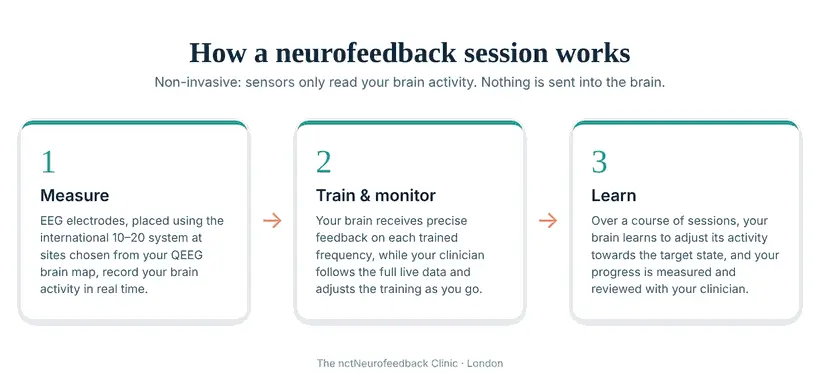
During a session, EEG electrodes are placed on the scalp at standard positions of the international 10–20 system, chosen from your QEEG brain map. Nothing is sent into the brain. The electrodes only record. Your brain receives precise real-time feedback on each trained frequency, while your clinician follows the full live data on screen and adjusts the training as the session goes. The target is not always a calmer or more relaxed state: depending on your brain map, training may aim to increase, reduce or stabilise particular rhythms, or to improve how brain regions work together.
Over a course of sessions, the brain learns to adjust its activity towards the target pattern more readily on its own, and your progress is measured and reviewed with your clinician along the way. Depending on your QEEG profile, training may target:
Coherence training to support more balanced communication between brain regions identified on your QEEG map.
Theta/beta and SMR training to support attention and steadier focus.
Beta training to support alertness and sustained attention.
Infra-low frequency (ILF) training to support the brain's regulation of arousal, which can be relevant for sleep and headaches.
HEG neurofeedback to train blood flow in the prefrontal cortex, the brain's planning and self-control centre.
What does the research show?
Research on neurofeedback after brain injury includes people with concussion and mild injuries as well as moderate injuries, and people training both in the early months of recovery and many years later. Several findings stand out:
Memory, attention and daily life. In a randomised controlled trial in Taiwan, 87 people with TBI and cognitive difficulties received ten weekly one-hour sessions of QEEG-guided z-score neurofeedback or theta/beta neurofeedback, or continued with usual care. Compared with usual care, the z-score group showed greater improvements in immediate and delayed recall, recognition memory and selective attention, along with greater gains in productive activity and community integration. The theta/beta group showed improvements in immediate memory and selective attention (Chen et al., 2023).
Back to work. In 26 people still living with symptoms between 3 and 70 months after a mild closed head injury, QEEG-guided coherence training was associated with an improvement of more than 50% in 88% of participants, after an average of 19 sessions. Everyone who had been working before the injury reported returning to work (Walker et al., 2002).
Attention in the early phase of recovery. In patients with moderate closed head injuries, ten sessions of beta training (13–20 Hz) were associated with greater improvement on attention tests than standard computerised attention training in a matched comparison group (Keller, 2001).
Headaches, sleep and quality of life. In a pilot study with veterans who had lived with the effects of mild TBI for 5 to 10 years, 20 sessions of infra-low frequency neurofeedback were associated with reductions in headache impact, insomnia and attention difficulties, together with improvements in quality of life (Carlson & Ross, 2021).
Changes visible on brain scans. In two young people with moderate TBI, 20 sessions of EEG neurofeedback were associated with better cognitive scores and fewer concussion symptoms, alongside MRI changes in grey matter volume and in the integrity of white matter pathways (Munivenkatappa et al., 2014).
As with any form of training, people progress at different rates. If you are curious why, our article on why some brains are less responsive to neurofeedback explores what shapes each person's learning curve, and our article on neurofeedback for stroke rehabilitation looks at a related area of brain recovery.
Summary of research in the field of neurofeedback training for traumatic brain injury
Study | Number of Subjects | Number of Sessions and Duration | Training Sites and Protocols | Results |
Chen et al., 2023 | 87 adults with TBI and cognitive impairment, randomised to z-score neurofeedback, theta/beta neurofeedback or usual care | 10 weekly 60-minute sessions over 10 weeks | QEEG-guided LORETA z-score neurofeedback; theta/beta neurofeedback | Z-score group: greater gains than usual care in immediate and delayed recall, recognition memory and selective attention, and in productive activity. Theta/beta group: gains in immediate memory and selective attention. |
Walker et al., 2002 | 26 adults with persistent symptoms 3 to 70 months after a mild closed head injury | Average of 19 sessions (up to 40); 5 sessions per QEEG abnormality | QEEG-guided coherence training to normalise coherence abnormalities | 88% improved by more than 50%; mean improvement 72.7%. All participants employed before the injury returned to work. |
Keller, 2001 | 21 patients with moderate closed head injury (12 neurofeedback, 9 matched controls) | 10 sessions | Beta (13–20 Hz) training, compared with standard computerised attention training | Greater improvement on attention tests than the comparison group. Duration of beta activity increased by about 50%. |
Carlson & Ross, 2021 | 4 veterans with mild TBI and 5 to 10 years of post-concussive symptoms | 20 sessions, 3 times per week | Infra-low frequency (ILF) training at T3-T4, T4-P4, T4-Fp2 and T3-Fp1 | Reductions in headache impact, insomnia and attention difficulties. Improvements in quality of life and wellbeing measures. |
Munivenkatappa et al., 2014 | 2 young people with moderate TBI | 20 sessions | EEG neurofeedback, with MRI before and after training | Improved cognitive scores and fewer concussion symptoms. Increased grey matter volume and white matter integrity on MRI. |
Neurofeedback for traumatic brain injury at The nctNeurofeedback Clinic in London
At our London clinic, every brain injury programme is built around your own brain, not a template:
Free consultation. We talk through your injury, your current symptoms, your goals and the support you already have, and whether neurofeedback is a good fit for you.
QEEG brain mapping. A detailed EEG assessment shows how your brain is working and which patterns are worth training.
A personalised training plan. Using the nctNeurofeedback Method, we select the protocols and sites that match your brain map, whether that's EEG neurofeedback, HEG or a combination.
Progress you can track. We monitor changes in your brain activity and in your everyday life, and adjust the training as you progress.
Neurofeedback works alongside your rehabilitation, never instead of it. We are happy to work alongside your GP, neurologist, physiotherapist, occupational therapist, speech and language therapist or neuropsychologist, so that everyone supporting your recovery can follow your progress. You can read more about training for adults on our neurofeedback for adults page.
Frequently asked questions
How many neurofeedback sessions might I need after a brain injury?
Research studies after brain injury have used between 10 and 40 sessions. Your own plan is based on your QEEG brain map, your symptoms and your goals, and we review progress regularly along the way.
Does neurofeedback hurt?
No. The electrodes only record your brain activity; nothing is sent into the brain. You sit comfortably while your clinician monitors your live brain data and guides the training.
My injury was years ago. Is it too late to train?
Studies have included people training in the early months of recovery as well as people living with symptoms from 3 months to 10 years after a mild brain injury, with improvements reported in attention, headaches and sleep. A free consultation is the best way to talk through your own situation.
Will I need to stop my current rehabilitation?
No. Neurofeedback is designed to work alongside your rehabilitation, never instead of it. Keep following the programme agreed with your rehabilitation team, and let them know you are training so everyone can follow your progress together.
Where can I get neurofeedback for traumatic brain injury in London?
The nctNeurofeedback Clinic offers neurofeedback, HEG and QEEG assessments in London. Book a free consultation to find out whether training is right for you.
Ready to find out how your brain could train?
Recovering from a brain injury takes patience, and you have already put in a great deal of effort. In a free, no-obligation consultation, we will listen to what daily life looks like for you now, explain how neurofeedback training works alongside your rehabilitation, and help you decide on the right next step.
References
Carlson, J., & Ross, G. W. (2021). Neurofeedback impact on chronic headache, sleep, and attention disorders experienced by veterans with mild traumatic brain injury: A pilot study. Biofeedback, 49(1), 2–9. https://doi.org/10.5298/1081-5937-49.01.01
Chen, P.-Y., Su, I.-C., Shih, C.-Y., Liu, Y.-C., Su, Y.-K., Wei, L., Luh, H.-T., Huang, H.-C., Tsai, P.-S., Fan, Y.-C., & Chiu, H.-Y. (2023). Effects of neurofeedback on cognitive function, productive activity, and quality of life in patients with traumatic brain injury: A randomized controlled trial. Neurorehabilitation and Neural Repair, 37(5), 277–287. https://doi.org/10.1177/15459683231170539
Headway. (n.d.). Brain injury statistics. https://www.headway.org.uk/brain-injury-statistics.aspx
Keller, I. (2001). Neurofeedback therapy of attention deficits in patients with traumatic brain injury. Journal of Neurotherapy, 5(1–2), 19–32. https://doi.org/10.1300/J184v05n01_03
Munivenkatappa, A., Rajeswaran, J., Indira Devi, B., Bennet, N., & Upadhyay, N. (2014). EEG neurofeedback therapy: Can it attenuate brain changes in TBI? NeuroRehabilitation, 35(3), 481–484. https://doi.org/10.3233/NRE-141140
Shah, S. A., Lowder, R. J., & Kuceyeski, A. (2020). Quantitative multimodal imaging in traumatic brain injuries producing impaired cognition. Current Opinion in Neurology, 33(6), 691–698. https://doi.org/10.1097/WCO.0000000000000872
Walker, J. E., Norman, C. A., & Weber, R. K. (2002). Impact of qEEG-guided coherence training for patients with a mild closed head injury. Journal of Neurotherapy, 6(2), 31–43. https://doi.org/10.1300/J184v06n02_05


Comments