
Neurofeedback for Adult ADHD: Training Focus When Your Brain Won't Stay on Task
It's 11 a.m. You sat down at 9 to finish one report. Since then you've answered three emails, reorganised your desktop, opened eleven browser tabs and remembered, with a jolt, the bill that was due yesterday. The report is still on its first paragraph. And the voice in your head is the same one that has followed you since school: why can't you just get on with it?
For many adults with ADHD, the hardest part isn't the distraction itself. It's the gap between what you know you are capable of and what you actually manage to get done, and the exhaustion, guilt and self-criticism that grow in that gap, day after day.
If you are living with adult ADHD, some of this will sound familiar:
The wall. You know exactly what needs doing, yet starting feels physically impossible, until a deadline turns it into a panic.
Time slipping away. Five minutes becomes an hour. Lateness, missed appointments and last-minute rushes become a pattern others notice.
A mind that won't switch off. Racing thoughts at night, restlessness in meetings, losing the thread of conversations.
Emotions on a hair-trigger. Frustration flares quickly, small setbacks feel huge, and the people closest to you feel it too.
Running on effort. You compensate with lists, alarms and sheer willpower, and end most days drained.
Neurofeedback for adult ADHD, in a nutshell
Brain-imaging and EEG research shows that ADHD is linked to differences in how the brain regulates its own activity: how it prepares for a task, holds attention on it, and puts the brakes on impulses. Neurofeedback is a scientifically based, measured way to train your brain to adjust its own activity towards a desired state. Your brain activity is recorded in real time, and a trained clinician monitors the live changes throughout each session, adjusts the training on the go and follows up on your progress.
In studies with adults with ADHD, training has been associated with improvements in attention, impulsivity and everyday ADHD symptoms after around 30 to 40 sessions, and in several studies these gains were maintained, and in some cases continued to grow, six months after training ended.

Prefer to ask a quick question first? Message us on WhatsApp.
Adult ADHD is more common, and more exhausting, than most people realise
ADHD is often pictured as a hyperactive child, but for many people it continues into adulthood, and many adults are only diagnosed in their thirties, forties or later. A global meta-analysis estimated that around 4.6% of adults live with ADHD that began in childhood, rising to almost 9% when adults with significant ADHD symptoms are included (Song et al., 2021).
In adults, ADHD is less about running around and more about executive function: the brain's management system for planning, prioritising, remembering what you were about to do, filtering distractions and regulating emotions. These difficulties show up at work, in relationships, with money and with sleep, and they are often mistaken for laziness or a lack of willpower. They are neither.
What is happening in the ADHD brain?
EEG (electroencephalography) measures the brain's electrical rhythms, or brainwaves. Research comparing adults with and without ADHD has found characteristic differences in these rhythms. For example, adult men with ADHD showed more slow theta activity and less fast beta activity, giving a higher theta/beta ratio, a pattern often linked to an under-aroused, drifting brain that struggles to stay on task (Dupuy et al., 2021).
Other adults show a different picture. One study found reduced alpha activity in adults with ADHD, a sign of a brain that is over-activated and finds it hard to settle (Deiber et al., 2020). Interestingly, research has also found that women with ADHD do not always show the classic male EEG pattern.
Why this matters: there is no single ADHD brain. Two people with the same diagnosis can have very different brainwave profiles, which is why we begin every training programme with a QEEG brain map assessment rather than a one-size-fits-all protocol.
How does neurofeedback training work?
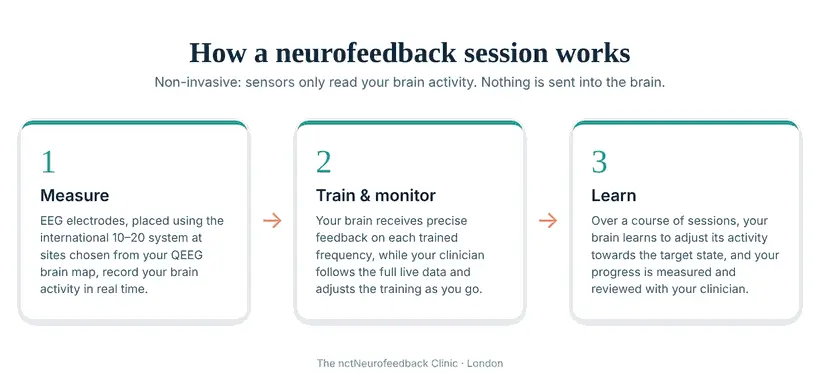
During a session, EEG electrodes are placed on the scalp at standard positions of the international 10–20 system, chosen from your QEEG brain map. Nothing is sent into the brain. The electrodes only record. Your brain receives precise real-time feedback on each trained frequency, while your clinician follows the full live data on screen and adjusts the training as the session goes. The target is not always a calmer or more relaxed state: depending on your brain map, training may aim to increase, reduce or stabilise particular rhythms.
Over a course of sessions, the brain learns to adjust its activity towards the target pattern more readily on its own, and your progress is measured and reviewed with your clinician along the way. Depending on your QEEG profile, training may target:
Theta/beta and SMR training to support sustained attention and steadier focus.
Slow cortical potential (SCP) training to strengthen the brain's ability to get ready for and stay with a task.
Alpha training to help an over-activated brain settle and improve impulse control.
HEG neurofeedback to train blood flow in the prefrontal cortex, the brain's planning and self-control centre.
What does the research show?
Research on neurofeedback for adult ADHD has grown steadily over the past decade. Several key findings stand out:
Lasting improvement in symptoms. In a study of 24 adults with ADHD, 30 sessions of slow cortical potential neurofeedback led to significant improvements on all ADHD and related symptom scales, with medium to large effects. These gains were still present six months later, and participants also became faster and more consistent on attention tasks (Mayer et al., 2016).
Better than waiting. In a randomised trial in Finland, 54 adults with ADHD or ADD received around 40 sessions of theta/beta or SMR neurofeedback, or were placed on a waiting list. The neurofeedback group reported improvements in their ADHD symptoms compared with the waiting-list group (Cowley et al., 2016).
Learning to self-regulate matters. In a randomised controlled trial with 67 adults, those who successfully learned to regulate blood flow in the prefrontal cortex showed a stronger reduction in ADHD symptoms at six-month follow-up, together with particularly low impulsivity ratings (Barth et al., 2021). This form of training is closely related to the HEG neurofeedback we offer at the clinic.
Effects that last. A meta-analysis of ten studies (mostly children and adolescents) found that the benefits of neurofeedback for inattention grew from a medium effect at the end of training to a large effect at follow-up, between two and twelve months later (Van Doren et al., 2019).
As with any form of training, people progress at different rates. If you are curious why, our article on why some brains are less responsive to neurofeedback explores what shapes each person's learning curve.
Summary of research in the field of neurofeedback training for adult ADHD
Study | Number of Subjects | Number of Sessions and Duration | Training Sites and Protocols | Results |
Mayer et al., 2016 | 24 adults with ADHD | 30 sessions Follow-up 6 months after training | Slow cortical potential (SCP) neurofeedback | All ADHD and related symptom scales improved significantly, with medium to large effects, after training and at 6-month follow-up. Reaction times became faster and more consistent. Participants who learned to self-regulate showed the greatest improvement at follow-up. |
Cowley et al., 2016 | 54 adults (44 ADHD, 10 ADD), randomised to neurofeedback or waiting list | About 40 one-hour sessions, 2 to 5 times per week | Theta/beta or SMR protocols | Self-reported ADHD symptoms improved in the neurofeedback group compared with the waiting-list group. |
Barth et al., 2021 | 67 adults with ADHD, randomised to SCP neurofeedback (26), fNIRS neurofeedback (21) or EMG biofeedback (20) | 30 sessions plus 3 booster sessions 6-month follow-up | SCP (EEG) neurofeedback Prefrontal blood-flow (fNIRS) neurofeedback | Significant improvement in ADHD symptoms across the training groups. Adults who learned to regulate prefrontal blood flow showed a stronger reduction in ADHD symptoms at 6-month follow-up and particularly low impulsivity ratings. |
Deiber et al., 2020 | 25 adults with ADHD and 22 healthy controls | Single 30-minute session | Alpha (8 to 12 Hz) neurofeedback, 64-channel EEG | Adults with ADHD successfully reduced alpha activity during training. Afterwards, their resting alpha moved towards the levels seen in controls, and greater normalisation was linked to fewer impulsive errors. |
Van Doren et al., 2019 (meta-analysis) | 10 studies, 506 participants (mainly children and adolescents) | Follow-up 2 to 12 months after training | Neurofeedback protocols used in ADHD research | Improvement in inattention grew from a medium effect after training to a large effect at follow-up. Improvements in hyperactivity and impulsivity were maintained. |
Neurofeedback for adult ADHD at The nctNeurofeedback Clinic in London
At our London clinic, every adult ADHD programme is built around your own brain, not a template:
Free consultation. We talk through your daily challenges, goals and history, and whether neurofeedback is a good fit for you.
QEEG brain mapping. A detailed EEG assessment shows how your brain is working and which patterns are worth training.
A personalised training plan. Using the nctNeurofeedback Method, we select the protocols and sites that match your brain map, whether that's EEG neurofeedback, HEG or a combination.
Progress you can track. We monitor changes in your brain activity and in your everyday life, and adjust the training as you progress.
Neurofeedback can sit comfortably within a wider support plan. We are happy to work alongside the care you receive from your GP, psychiatrist, therapist or ADHD coach. You can read more about our approach on our neurofeedback for ADHD page.
Frequently asked questions
How many neurofeedback sessions will I need for adult ADHD?
Most research studies with adults used between 30 and 40 sessions. Your own plan is based on your QEEG brain map and goals, and we review progress regularly along the way.
Does neurofeedback hurt?
No. The electrodes only record your brain activity; nothing is sent into the brain. You sit comfortably while your clinician monitors your live brain data and guides the training.
I was diagnosed late, or I suspect I have ADHD but have no diagnosis. Can I still train?
Yes. Neurofeedback trains attention, focus and self-regulation, whatever your diagnosis status. A formal ADHD diagnosis comes from a psychiatrist or specialist clinician, and we are happy to work alongside them.
Do the results last?
Neurofeedback is a learning process, and studies in adults have found that improvements were maintained six months after training ended, and in some cases continued to grow.
Where can I get neurofeedback for ADHD in London?
The nctNeurofeedback Clinic offers neurofeedback, HEG and QEEG assessments in London. Book a free consultation to find out whether training is right for you.
Ready to see how your brain could train?
You have spent years working harder than everyone else just to keep up. In a free, no-obligation consultation, we will listen to what daily life with ADHD looks like for you, explain how neurofeedback training works, and help you decide on the right next step.
References
Barth, B., Mayer-Carius, K., Strehl, U., Wyckoff, S. N., Haeussinger, F. B., Fallgatter, A. J., & Ehlis, A.-C. (2021). A randomized-controlled neurofeedback trial in adult attention-deficit/hyperactivity disorder. Scientific Reports, 11, 16873. https://doi.org/10.1038/s41598-021-95928-1
Cowley, B., Holmström, É., Juurmaa, K., Kovarskis, L., & Krause, C. M. (2016). Computer enabled neuroplasticity treatment: A clinical trial of a novel design for neurofeedback therapy in adult ADHD. Frontiers in Human Neuroscience, 10, 205. https://doi.org/10.3389/fnhum.2016.00205
Deiber, M.-P., Hasler, R., Colin, J., Dayer, A., Aubry, J.-M., Baggio, S., Perroud, N., & Ros, T. (2020). Linking alpha oscillations, attention and inhibitory control in adult ADHD with EEG neurofeedback. NeuroImage: Clinical, 25, 102145. https://doi.org/10.1016/j.nicl.2019.102145
Dupuy, F. E., Clarke, A. R., Barry, R. J., McCarthy, R., & Selikowitz, M. (2021). DSM-5 adult attention-deficit/hyperactivity disorder: Sex differences in EEG activity. Applied Psychophysiology and Biofeedback, 46(4), 377–388. https://doi.org/10.1007/s10484-021-09522-2
Mayer, K., Blume, F., Wyckoff, S. N., Brokmeier, L. L., & Strehl, U. (2016). Neurofeedback of slow cortical potentials as a treatment for adults with attention deficit-/hyperactivity disorder. Clinical Neurophysiology, 127(2), 1374–1386. https://doi.org/10.1016/j.clinph.2015.11.013
Song, P., Zha, M., Yang, Q., Zhang, Y., Li, X., & Rudan, I. (2021). The prevalence of adult attention-deficit hyperactivity disorder: A global systematic review and meta-analysis. Journal of Global Health, 11, 04009. https://doi.org/10.7189/jogh.11.04009
Van Doren, J., Arns, M., Heinrich, H., Vollebregt, M. A., Strehl, U., & Loo, S. K. (2019). Sustained effects of neurofeedback in ADHD: A systematic review and meta-analysis. European Child & Adolescent Psychiatry, 28(3), 293–305. https://doi.org/10.1007/s00787-018-1121-4


Comments