
Neurofeedback for Stroke Rehabilitation: Helping Your Brain Relearn
It's 8 a.m. and the kettle has just boiled. You reach for your mug with your right hand, the way you have done every morning for fifty years, and your fingers simply won't close around the handle. You try again, slower this time, watching your hand as if watching might help. In physio yesterday you managed it twice. Today, nothing. You can hear the family moving about upstairs, and you know someone will offer to help in a moment. You'll say yes, because you have to. But the voice in your head is louder than theirs: why won't my body do what I tell it?
For many people recovering from a stroke, the hardest part isn't the hard work of rehabilitation; it's how slowly progress can come, and the frustration of a body and brain that no longer seem to be on speaking terms.
If you are recovering from a stroke, or supporting someone who is, some of this will sound familiar:
The hand that won't listen. You know exactly what you want it to do, but the message seems to get lost on the way.
The plateau. The first weeks brought visible gains; now progress feels painfully slow, even though you are working just as hard.
The fog. Concentrating, remembering what was said at an appointment or following a conversation in a busy room takes far more effort than it used to.
The tiredness. Ordinary tasks leave you exhausted, and by the afternoon there is little left for your exercises.
The loss of independence. Needing help with things you have always done yourself can be harder than any of the physical changes.
Neurofeedback for stroke rehabilitation, in a nutshell
A stroke disrupts the networks that let different areas of the brain work together, and these changes show up in the brain's electrical activity: more slow-wave activity over the affected areas and an imbalance between the two hemispheres (Milani et al., 2022). Neurofeedback is a scientifically based, measured way to train the brain to adjust its activity towards a desired state. Your brain activity is recorded live, and your clinician monitors it and adjusts the training throughout every session.
In studies with people recovering from stroke, neurofeedback added to standard rehabilitation has been associated with greater improvements in arm and hand movement, walking and balance, and memory than rehabilitation alone or sham training. It works alongside your rehabilitation team (physiotherapy, occupational therapy, speech and language therapy and neurology), never instead of it.

Prefer to ask a quick question first? Message us on WhatsApp.
Stroke is common, and recovery is a long road
According to the Stroke Association, around 100,000 people in the UK have a stroke each year, roughly one every five minutes, and about 1.4 million stroke survivors are living in the UK today (Stroke Association, n.d.).
The effects depend on where the stroke happened and how much of the brain it affected. For some people it is weakness down one side of the body, a hand that won't grip or a leg that drags. For others it is the less visible changes: difficulty concentrating, remembering or finding words, fatigue that a night's sleep doesn't fix, and a knock to mood and confidence. Recovery often continues for months and years, and much of it comes through the steady, repeated practice of rehabilitation.
What is happening in the brain after a stroke?
EEG (electroencephalography) measures the brain's electrical rhythms, which are grouped into frequency bands such as delta, theta, alpha and beta. After a stroke, EEG commonly shows more slow activity (delta and theta) and less faster activity (alpha and beta). Researchers also look at the balance between the two hemispheres and at the delta/alpha ratio as markers of how the brain is coping (Milani et al., 2022).
A scoping review of EEG and arm recovery found that several of these measures have been associated with how well movement returns: greater imbalance between the hemispheres generally tracked with poorer recovery, while a fall in the delta/alpha ratio over the affected hemisphere in the months after a stroke was linked to a better long-term outlook (Milani et al., 2022). Movement leaves its own signature too: when we prepare or imagine a movement, the sensorimotor rhythms over the motor cortex (around electrode sites C3 and C4) briefly decrease. Several of the training approaches described below work directly with this signal.
Why this matters: no two strokes are the same. The location and size of the stroke, the time since it happened and your own goals all shape your brain activity, which is why we begin every training programme with a QEEG brain map assessment rather than a one-size-fits-all protocol.
How does neurofeedback training work?
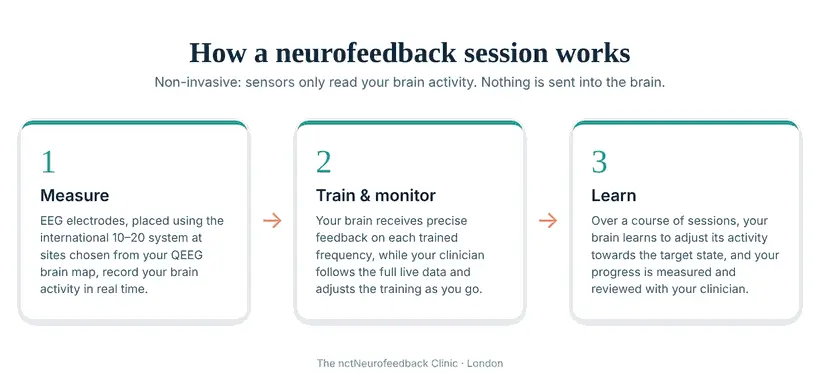
During a session, EEG electrodes are placed on the scalp at standard positions of the international 10-20 system, chosen from your QEEG brain map. The electrodes only record; nothing is sent into the brain. The system gives precise, real-time feedback on each trained frequency, while your clinician follows the full live data and adjusts the training as you go.
The target is not always a calmer state. After a stroke, training may aim to strengthen activity over the motor areas during imagined or attempted movement, to improve communication between brain regions, or to support steadier attention and memory. Over a course of sessions, the brain learns to adjust its activity towards the desired state, and your progress is measured and reviewed with your clinician. Depending on your QEEG map and goals, training may include:
Sensorimotor rhythm (SMR) and mu-rhythm training over the motor cortex (C3, C4, Cz), often paired with imagined or attempted movement, to support arm and hand function.
Alpha connectivity training to support communication between the motor cortex and the rest of the movement network.
SMR and upper-alpha training to support memory and concentration.
HEG neurofeedback, which trains blood flow (oxygenation) in specific areas of the cortex. Research with a related technique, fNIRS, has trained motor and premotor areas after stroke.
What does the research show?
Research on neurofeedback in stroke rehabilitation has grown over the past decade. Most of it focuses on movement, with a smaller body of work on memory and thinking, and in nearly all of these studies neurofeedback was added to standard rehabilitation rather than replacing it.
Arm and hand movement. In a double-blind, sham-controlled study of 32 people with chronic stroke and severe hand weakness, training to change sensorimotor rhythms over the affected hemisphere, linked to a hand and arm orthosis and followed by physiotherapy, was associated with significantly greater improvement in arm function (Fugl-Meyer scores) than sham training (Ramos-Murguialday et al., 2013). In a controlled study of 24 patients, adding mu-rhythm training to conventional therapy was associated with larger gains in arm function at four weeks (Li et al., 2022).
Connecting the movement network. In a double-blind crossover study, ten people with chronic stroke trained alpha-band connectivity of the motor cortex over eight sessions. Motor-cortex training was associated with greater improvement in arm function than training a control region, and the change in connectivity correlated with the improvement in movement (Mottaz et al., 2018).
Blood-flow neurofeedback. In a randomised pilot study of 20 people after subcortical stroke, six sessions of motor imagery with fNIRS neurofeedback from the premotor cortex, added to standard rehabilitation, were associated with greater recovery of hand and finger movement than sham feedback (Mihara et al., 2013). A larger double-blind randomised trial of 54 patients found that six sessions of fNIRS neurofeedback targeting the supplementary motor area were associated with greater improvement in walking and balance than sham (Mihara et al., 2021).
Memory after stroke. In a study of stroke patients, up to ten sessions of SMR or upper-alpha neurofeedback were associated with improvements in verbal short- and long-term memory, with stronger gains than traditional cognitive training (Kober et al., 2015).
As with any form of rehabilitation, people progress at different rates. If you'd like to know what the research could mean for you, we're happy to talk it through at a free consultation.
Summary of research in the field of neurofeedback training for stroke rehabilitation
Study | Number of Subjects | Number of Sessions and Duration | Training Sites and Protocols | Results |
Ramos-Murguialday et al., 2013 | 32 adults with chronic stroke and severe hand weakness (16 neurofeedback, 16 sham) | Training over about 18 days, each session followed by physiotherapy | Ipsilesional sensorimotor rhythm desynchronisation controlling a hand and arm orthosis | Significantly greater improvement in arm function (combined Fugl-Meyer) than sham. Gains correlated with changes in brain activation (fMRI) and hand muscle activity. |
Mihara et al., 2013 | 20 adults with subcortical stroke (neurofeedback vs sham) | 6 sessions, added to standard rehabilitation | fNIRS neurofeedback from the premotor cortex during motor imagery of the hand | Greater gains in hand and finger function (Fugl-Meyer) than sham. Greater premotor activation during imagery; the effect was also seen in severely affected participants. |
Kober et al., 2015 | 24 stroke patients (11 SMR, 6 upper alpha, 7 usual care) | Up to 10 sessions of about 45 min, 3-5 per week | SMR (12-15 Hz) at Cz; upper alpha (individual alpha frequency +2 Hz) at Pz | Both neurofeedback groups improved verbal short- and long-term memory. Gains were stronger than with traditional cognitive training. |
Mottaz et al., 2018 | 10 adults with chronic stroke (controlled crossover) | 8 sessions per arm, twice weekly for a month; 50 min of training each | Alpha-band (8-12 Hz) connectivity of the ipsilesional motor cortex hand area vs a control region | Arm function improved by 5.3 Fugl-Meyer points after motor training vs 2.0 after control training. The change in motor-cortex connectivity correlated with motor improvement (r = 0.76). |
Mihara et al., 2021 | 54 adults with subcortical stroke (28 neurofeedback, 26 sham) | 6 sessions | fNIRS neurofeedback of the supplementary motor area during gait and balance motor imagery | Greater improvement in walking and balance (Timed Up-and-Go 12.8 s vs 5.5 s faster). Increased supplementary motor area activation and connectivity in the neurofeedback group only. |
Li et al., 2022 | 24 stroke patients with moderate-to-severe hand paralysis (12 neurofeedback, 12 control) | 10 sessions; 1 h neurofeedback plus 2 h conventional therapy per day | Mu rhythm (8-12 Hz) at C3/C4 with motor imagery, motor observation and exoskeleton feedback | Greater arm function gains at week 4 (Fugl-Meyer +13.2 vs +6.0). All neurofeedback participants exceeded the minimal clinically important difference. |
Neurofeedback for stroke rehabilitation at The nctNeurofeedback Clinic in London
At our London clinic, every stroke rehabilitation programme is built around your brain, your goals and the work you are already doing with your rehabilitation team:
Free consultation. We talk through your stroke, your current rehabilitation, your daily challenges and what you would most like to get back to.
QEEG brain mapping. A detailed map of your brain activity shows how your brain is working now and guides where and how to train.
A personalised plan using the nctNeurofeedback Method. Your training sites, frequencies and goals are chosen from your QEEG map, and your clinician adjusts them as you progress.
Progress you can track. We measure and review changes with you regularly, so you can see how your brain activity and your everyday life are changing.
Neurofeedback works alongside your rehabilitation team, never instead of it. We are happy to work with your GP, neurologist, physiotherapist, occupational therapist or speech and language therapist as part of your wider support plan. You can read more about neurofeedback for adults at our clinic.
Frequently asked questions
Can neurofeedback replace my physiotherapy or rehabilitation?
No. Neurofeedback is designed to work alongside your rehabilitation team, including physiotherapy, occupational therapy, speech and language therapy and neurology. In the studies above, it was added to standard rehabilitation, not used instead of it.
How many neurofeedback sessions will I need after a stroke?
Research studies used between 6 and around 18 sessions. Your own plan is based on your QEEG brain map and goals, and we review progress regularly along the way.
Is it too late if my stroke was years ago?
Several of the studies above included people months or years after their stroke, and training was associated with improvements in movement (Ramos-Murguialday et al., 2013; Mottaz et al., 2018). Everyone is different, and a QEEG assessment helps us understand where your brain is now.
Can neurofeedback help with memory and concentration after a stroke?
In one study, SMR and upper-alpha neurofeedback were associated with improvements in verbal memory after stroke (Kober et al., 2015). Your QEEG map helps us decide whether training for memory and concentration is right for you.
Where can I get neurofeedback for stroke rehabilitation in London?
At The nctNeurofeedback Clinic in London. Every programme starts with a free consultation and a QEEG brain map. Book your free consultation to find out whether neurofeedback could support your recovery.
Ready to take the next step in your recovery?
You have already put so much work into getting where you are. Neurofeedback offers a measured, closely monitored way to train your brain alongside the rehabilitation you are already doing. Book a free consultation and we'll talk through your recovery, your goals and whether neurofeedback could support you.
References
Kober, S. E., Schweiger, D., Witte, M., Reichert, J. L., Grieshofer, P., Neuper, C., & Wood, G. (2015). Specific effects of EEG based neurofeedback training on memory functions in post-stroke victims. Journal of NeuroEngineering and Rehabilitation, 12, 107. https://doi.org/10.1186/s12984-015-0105-6
Li, X., Wang, L., Miao, S., Yue, Z., Tang, Z., Su, L., Zheng, Y., Wu, X., Wang, S., Wang, J., & Dou, Z. (2022). Sensorimotor rhythm-brain computer interface with audio-cue, motor observation and multisensory feedback for upper-limb stroke rehabilitation: A controlled study. Frontiers in Neuroscience, 16, 808830. https://doi.org/10.3389/fnins.2022.808830
Mihara, M., Fujimoto, H., Hattori, N., Otomune, H., Kajiyama, Y., Konaka, K., Watanabe, Y., Hiramatsu, Y., Sunada, Y., Miyai, I., & Mochizuki, H. (2021). Effect of neurofeedback facilitation on poststroke gait and balance recovery: A randomized controlled trial. Neurology, 96(21). https://doi.org/10.1212/WNL.0000000000011989
Mihara, M., Hattori, N., Hatakenaka, M., Yagura, H., Kawano, T., Hino, T., & Miyai, I. (2013). Near-infrared spectroscopy-mediated neurofeedback enhances efficacy of motor imagery-based training in poststroke victims: A pilot study. Stroke, 44(4), 1091-1098. https://doi.org/10.1161/STROKEAHA.111.674507
Milani, G., Antonioni, A., Baroni, A., Malerba, P., & Straudi, S. (2022). Relation between EEG measures and upper limb motor recovery in stroke patients: A scoping review. Brain Topography, 35(5-6), 651-666. https://doi.org/10.1007/s10548-022-00915-y
Mottaz, A., Corbet, T., Doganci, N., Magnin, C., Nicolo, P., Schnider, A., & Guggisberg, A. G. (2018). Modulating functional connectivity after stroke with neurofeedback: Effect on motor deficits in a controlled cross-over study. NeuroImage: Clinical, 20, 336-346. https://doi.org/10.1016/j.nicl.2018.07.029
Ramos-Murguialday, A., Broetz, D., Rea, M., Läer, L., Yilmaz, Ö., Brasil, F. L., Liberati, G., Curado, M. R., Garcia-Cossio, E., Vyziotis, A., Cho, W., Agostini, M., Soares, E., Soekadar, S., Caria, A., Cohen, L. G., & Birbaumer, N. (2013). Brain-machine interface in chronic stroke rehabilitation: A controlled study. Annals of Neurology, 74(1), 100-108. https://doi.org/10.1002/ana.23879
Stroke Association. (n.d.). Stroke statistics. https://www.stroke.org.uk/stroke/statistics


Comments